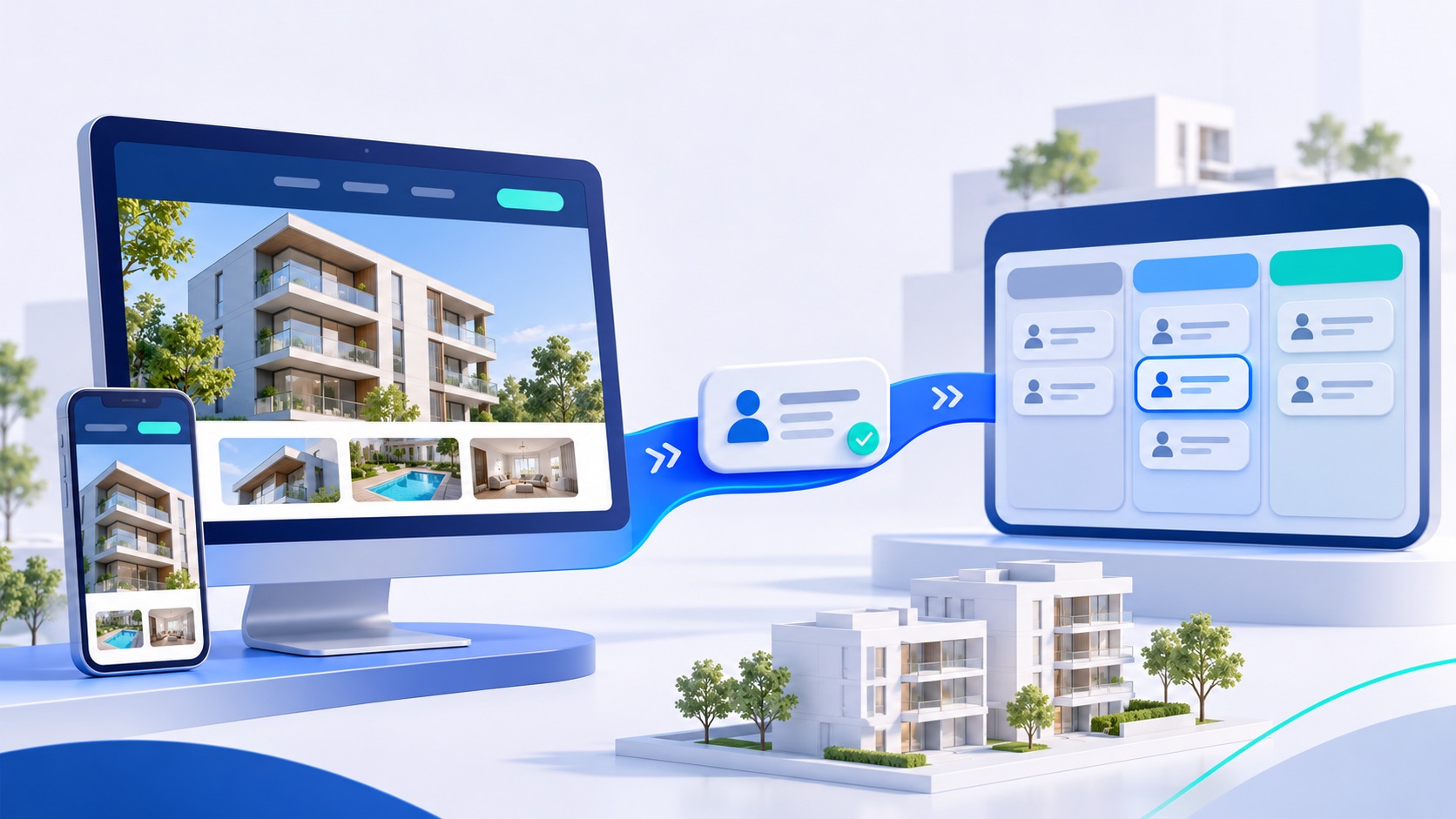
In most real estate operations, the website and the sales tools work separately. An agency or a provider builds the website, an independent service hosts it, and someone updates it when time allows. Lead follow-up happens elsewhere: in a CRM, a spreadsheet or each advisor’s WhatsApp conversations.
Between them sits a task that nobody formally owns: moving each form submission into the system used for follow-up, deciding who should handle it and keeping the website aligned with what is actually available. That work exists in almost every operation, and it is usually done manually.
When we decided to bring websites into Nuboo, we started with a premise: manually transferring leads between the website and the CRM should not be necessary.
Where interest becomes an opportunity
A website is often treated as a design project with a beginning and an end: it is commissioned, delivered and published. From an operational perspective, however, it serves another purpose. It is the point where a person’s interest becomes information the sales team can act on.
If that information originates outside the system used to manage the customer relationship, every subsequent step depends on somebody transferring it. In real estate sales, avoiding that manual transfer helps the team carry the request forward from the first contact.
That is why we chose to build websites as part of the platform, with access to the catalog and the CRM, rather than connecting an external page builder.
Forms that enter the sales workflow
Forms are designed in the same editor as the pages. Alongside contact details, each company defines the questions it needs to understand a person’s interests.
When submitted, a request enters Nuboo’s lead intake together with its origin: the site, page and form where it was generated. From that point, it follows the intake and distribution rules configured for the operation.
The team receives a lead with context for starting a conversation and following up according to its assignment rules.
A catalog connected to what you can sell
In pre-construction sales (selling properties before construction is complete), the offer changes constantly: units are reserved, new stages open and some projects finish their commercial cycle. On an independent website, each change requires a manual update, and delays can leave customers looking at inaccurate information.
In Nuboo, the developments shown on the website come from the same catalog used by the sales team. The company decides which projects to display and how to present them. Catalog blocks check that those projects remain eligible for commercialization. When a development widget is included, the site plan, inventory and availability are queried from the platform.
This keeps the offer connected to the catalog aligned with current commercial eligibility.
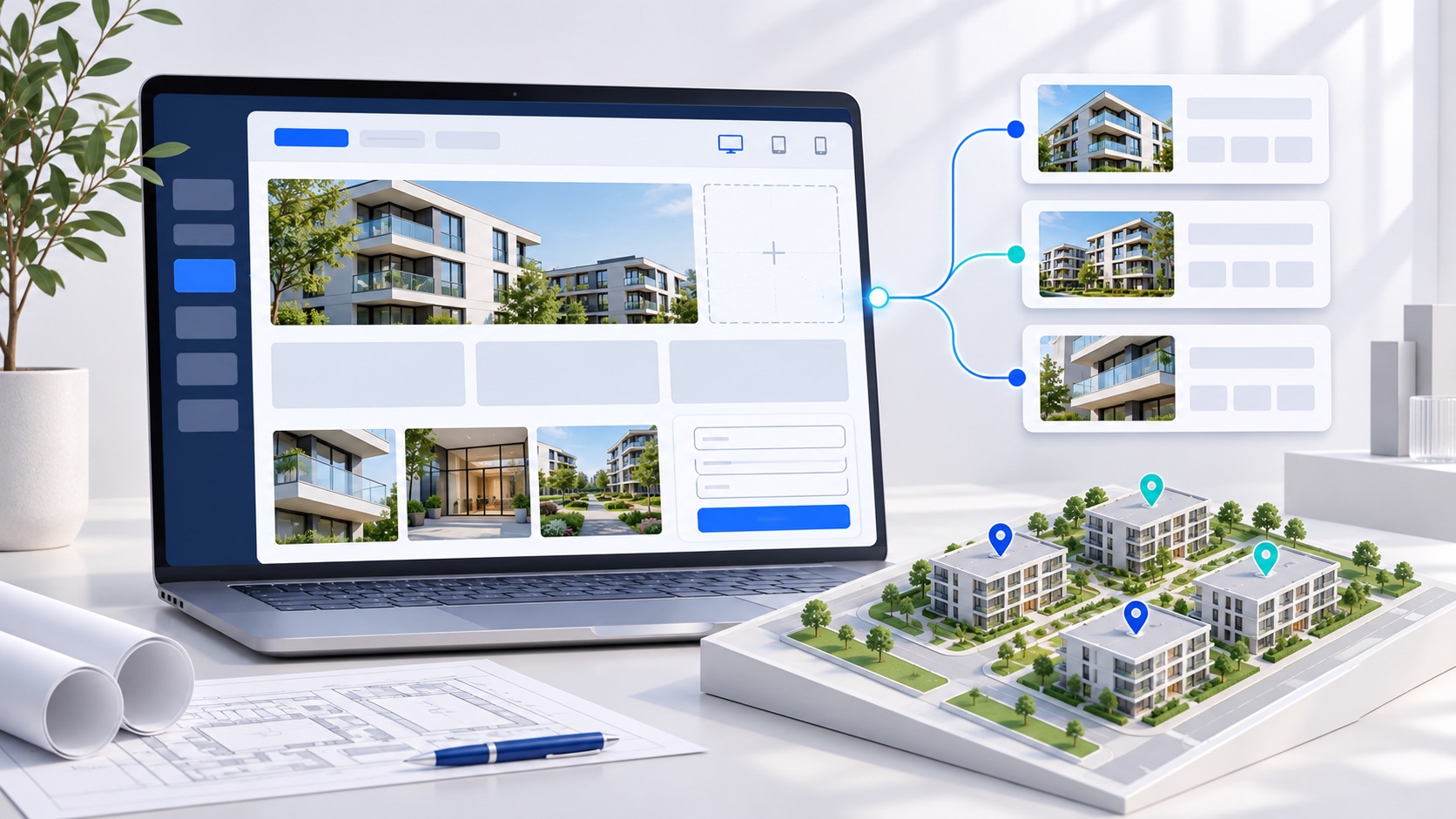
Conceptual illustration, not a screenshot of the Nuboo interface.
Design, review and publish from the platform
The editor includes templates that can be adapted to each company’s identity, for both institutional websites and landing pages for projects or campaigns. Teams needing more control can also work directly with HTML and CSS.
Changes are prepared as drafts and published when ready, keeping the current public version in place while work continues.
Fewer separate pieces to manage
Bringing websites into the platform has consequences beyond convenience.
First, it brings together pieces that are usually purchased and managed separately. The editor, templates, forms and publishing are managed within Nuboo, with predictable costs based on the resources selected and without managing independent hosting.
Second, the website uses Nuboo’s catalog and lead intake. That workflow does not require configuring and maintaining an external connector between a page builder and the CRM.
Public pages are generated as static files. The visual editor stays inside Nuboo, while catalog and lead intake features communicate with the platform. This separation allows content to be published without installing an editor or CRM on every public website.
The static architecture is designed for performance. When preparing a page, it is also worth keeping image sizes under control and checking the experience on a phone, especially when the page is a campaign destination.
Finally, measurement remains in the tools the team already uses: the system supports Google Analytics 4, Google Tag Manager and Meta Pixel in the published version.
The beginning of commercial work
For a long time, the website has been the point where marketing’s work ends. Our proposal is that it should be the point where commercial work begins.
When the website, catalog and CRM work within the same system, a customer’s request does not depend on somebody reviewing and transferring it. It reaches the team responsible for handling it, with the information needed to follow up.